Month: September 2022

  • -

George Habash

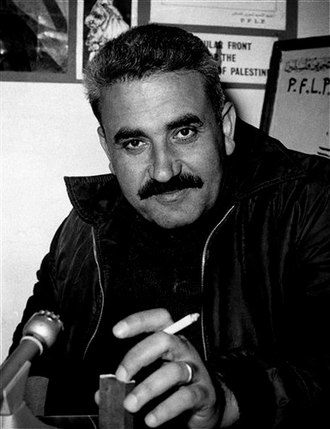
George Habash (Arabic: جورج حبش), also known by his laqab “al-Hakim” (Arabic: الحكيم, “the wise one” or “the doctor”; 2 August 1926 – 26 January 2008) was a Palestinian Christian politician who founded the Marxist–LeninistPopular Front for the Liberation of Palestine (PFLP). Habash served as General Secretary of the PFLP until 2000, when ill health forced him to resign.[1][2][3]

Habash was born in Lydda (today’s Lod) to an Eastern Orthodox Palestinian family in 1926.[4][5] As a child, he sang in the church choir.[6] Habash, a medical student at the American University of Beirut, was visiting his family during the 1948 Arab–Israeli war. In July 1948, the Israeli Defence Force captured Lydda from Jordanian and Arab Liberation Army forces, resulting in all of the town’s Arab residents leaving and the death of Habash’s sister. Habash and his remaining family became refugees and were not allowed to return home.

Political thinkers who were influences on Habash at this period included Constantin Zureiq, whose lectures at AUB on ‘Arab nationalism and the Zionist danger’ in the late 1940s and early 1950s Habash had attended, and Sati’ al-Husri an Arab Muslim intellectual who emphasized national cohesiveness, territorial patriotism, and loyalty to the state, and gave priority to Arab unity over Islamic unity.[7]

In 1951, after graduating first in his class from medical school, Habash worked in refugee camps in Jordan and ran a clinic with Wadie Haddad in Amman. He firmly believed that the state of Israel should be ended by all possible means, including political violence.[8] In an effort to recruit the Arab world to this cause, Habash founded the Arab Nationalist Movement (ANM) in 1951 and aligned the organization with Gamal Abdel Nasser‘s Arab nationalist ideology.

He was implicated in the 1957 coup attempt in Jordan, which had originated among Palestinian members of the National Guard. Habash was convicted in absentia, after having gone underground when Hussein of Jordan proclaimed martial law and banned all political parties. In 1958 he fled to Syria (then part of the United Arab Republic), but was forced to return to Beirut in 1961 by the tumultuous breakup of the UAR.

Habash was a leading member of the Palestine Liberation Organization until 1967 when he was sidelined by Fatah leader Yasser Arafat, with whom he had a complex relationship described as a mix of “camaraderie and rivalry” and “a love-hate relationship”.[9][10] In response, Habash founded the Popular Front for the Liberation of Palestine.

web

wikipedia DEwikipedia EN – wikipedia XY

youtube – vimeo – soundcloud

facebook – twitter – instagram – XING

work

  • -

Radovan Karadžić

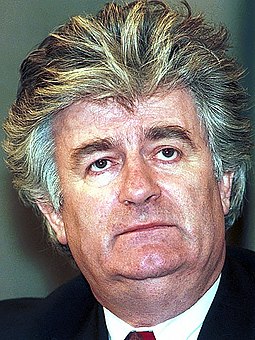
Radovan Karadžić (Serbian Cyrillic: Радован Караџић, pronounced [râdoʋaːn kâradʒitɕ]; born 19 June 1945) is a Bosnian Serb psychiatrist, poet and former politician who served as the president of Republika Srpska during the Bosnian War, and was later convicted of genocidecrimes against humanity and war crimes by the International Criminal Tribunal for the former Yugoslavia (ICTY).[2]

Trained as a psychiatrist, he co-founded the Serb Democratic Party in Bosnia and Herzegovina and served as the first president of Republika Srpska from 1992 to 1996. He was a fugitive from 1996 until July 2008, after having been indicted for war crimes by the ICTY.[3] The indictment concluded there were reasonable grounds for believing he committed war crimes, including genocide against Bosniak and Croat civilians during the Bosnian War (1992–1995).[3] While a fugitive, he worked at a private clinic in Belgrade, specializing in alternative medicine and psychology, under an alias.[4]

He was arrested in Belgrade on 21 July 2008 and brought before Belgrade’s War Crimes Court a few days later.[3] Extradited to the Netherlands, he was placed in the custody of the International Criminal Tribunal for the former Yugoslavia in the United Nations Detention Unit of Scheveningen, where he was charged with 11 counts of war crimes and crimes against humanity.[5][6] He is sometimes referred to by the Western media as the “Butcher of Bosnia”,[7][8][9] a sobriquet also applied to former Army of Republika Srpska (VRS) General Ratko Mladić.[10][11][12] On 24 March 2016, he was found guilty of the genocide in Srebrenica, war crimes, and crimes against humanity, 10 of the 11 charges in total, and sentenced to 40 years’ imprisonment.[13][14] On 22 July 2016, he filed an appeal against his conviction. The appeal was rejected on 20 March 2019, and the sentence was increased to life imprisonment.[15] In May 2021, it was announced that he would be transferred to a British prison.[16]

web

wikipedia DEwikipedia EN – wikipedia XY

youtube – vimeo – soundcloud

facebook – twitter – instagram – XING

work

  • -

Bashar Hafez al-Assad

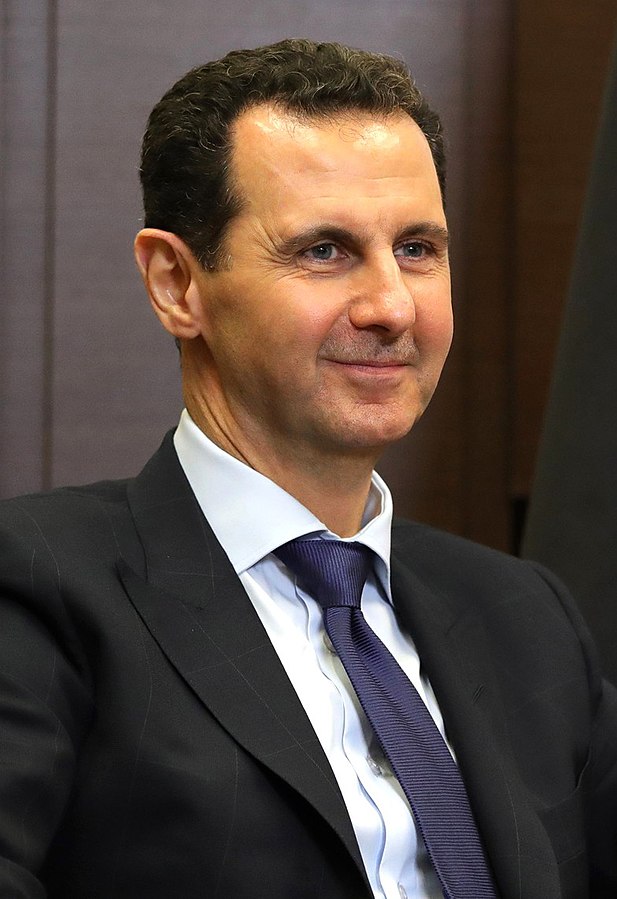
Bashar Hafez al-Assad[a] (Arabic: بَشَّارُ ٱلْأَسَدِ, born 11 September 1965) is a Syrian politician who is the 19th president of Syria, since 17 July 2000. In addition, he is the commander-in-chief of the Syrian Armed Forces and the Secretary-General of the Central Command of the Arab Socialist Ba’ath Party.

His father, Hafez al-Assad, was the president of Syria before him, serving from 1971 to 2000. Born and raised in Damascus, Bashar al-Assad graduated from the medical school of Damascus University in 1988 and began to work as a doctor in the Syrian Army. Four years later, he attended postgraduate studies at the Western Eye Hospital in London, specialising in ophthalmology. In 1994, after his elder brother Bassel died in a car accident, Bashar was recalled to Syria to take over Bassel’s role as heir apparent. He entered the military academy, taking charge of the Syrian military presence in Lebanon in 1998.

Political scientists have characterised the Assad family’s rule of Syria as a personalist dictatorship.[b] On 17 July 2000, Assad became president, succeeding his father, who died in office on 10 June 2000. In the 2000 and 2007 elections, he received 97.29% and 97.6% support, respectively.[c] On 16 July 2014, Assad was sworn in for another seven-year term after another election gave him 88.7% of the vote.[d] The election was held only in areas controlled by the Syrian government during the country’s ongoing civil war and was criticised by the United Nations (UN).[21][22] Assad was re-elected in 2021 with over 95% of the vote in national election. Throughout his leadership, human rights groups have characterized Syria’s human rights situation as poor. The Assad government describes itself as secular,[23] while some political scientists write that his regime exploits sectarian tensions in the country.[24][25]

Assad received his primary and secondary education in the Arab-French al-Hurriya School in Damascus.[41] In 1982, he graduated from high school and then studied medicine at Damascus University.[47]

web

wikipedia DEwikipedia EN – wikipedia XY

youtube – vimeo – soundcloud

facebook – twitter – instagram – XING

work